Description:
A resonance energy transfer (RET)–engineered nanoplatform enabling complete tumor ablation using near-infrared irradiation
Background
Photothermal therapy (PTT) uses NIR light to generate localized tumor heating. However, many systems require elevated laser power densities to achieve therapeutic temperatures, limiting translational feasibility. A systemically deliverable photothermal agent capable of operating within low-power irradiation parameters is needed to advance oncology applications.
Technology Description
This technology enables systemic, image-guided photothermal tumor ablation using near-infrared (NIR) irradiation at clinically relevant laser power levels (0.25 W/cm²). The platform uses resonance energy transfer (RET) between plasmonic nanorods and a near-infrared dye to amplify photothermal heating while retaining fluorescence imaging capability.
In an aggressive transgenic melanoma mouse model, a single treatment following intravenous administration resulted in complete tumor ablation under low-power irradiation conditions.
The invention is a resonance energy transfer (RET)-engineered nanoplatform composed of:
- Gold nanorods (AuNRs)
- An ultrathin (~3.5 nm) iron/cobalt (Fe/Co) nanoshell
- Silicon naphthalocyanine (SiNc) NIR dye
- A biodegradable PEG–PCL polymer carrier
The Fe/Co shell red-shifts the nanorod surface plasmon resonance (~783 nm) to align with the SiNc absorption peak (~780 nm), enabling efficient non-radiative RET. This spectral alignment enhances light-to-heat conversion under 780 nm irradiation at 0.25 W/cm².
Under these conditions, the co-loaded nanoagent demonstrated:
- 6.6-fold higher photothermal performance compared to dye alone
- 3.3-fold higher performance compared to Fe/Co-AuNRs alone
- 2.3-fold higher performance compared to AuNR + dye without the Fe/Co shell
The PEG–PCL carrier enables aqueous stability and intravenous administration, with a hydrodynamic diameter of approximately 115 nm. Fluorescence imaging capability is retained, supporting image-guided treatment.
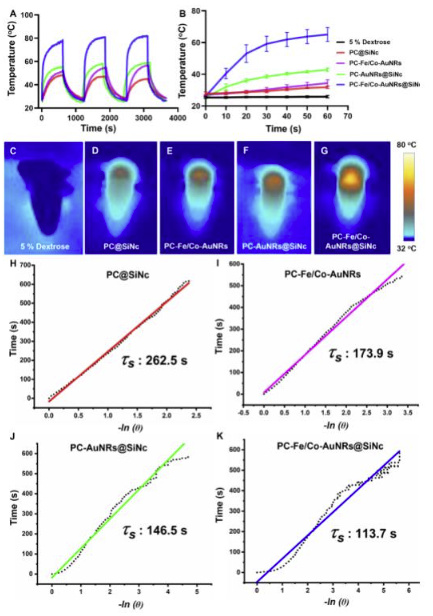
Under low-power NIR irradiation (780 nm, 0.25 W/cm²), the RET-engineered PC-Fe/Co-AuNRs@SiNc nanoagent demonstrated rapid temperature elevation and reached ~80 °C (ΔT ≈ 55 °C) after 10 minutes of irradiation. In comparison, dye alone and Fe/Co-AuNRs alone achieved maximum temperatures of ~46 °C and ~51 °C, respectively. These results demonstrate enhanced photothermal heating under low-power NIR irradiation (0.25 W/cm²). Repeated laser on/off cycling showed no measurable loss of heating performance across irradiation cycles.
Further Details:
Features & Benefits
- Operates at low-power NIR irradiation within commonly referenced skin exposure limits /span>
- Demonstrated in vivo therapeutic efficacy
- Systemically deliverable formulation
- Mechanistically defined RET-driven enhancement
Applications
- Image-guided photothermal therapy for melanoma
- Treatment of solid tumors accessible to NIR irradiation
- Theranostic oncology platforms
- Combination strategis integrating imaging and localized tumor ablation
Stage of Development
- Preclinical in vivo efficacy demonstrated
- Systemic (IV) administration validated
- Complete tumor ablation achieved in a transgenic melanoma mouse model
- Manuscript submitted