Description:
This is a composite, clay-based concrete formulation that sets very rapidly upon extrusion, enabling rapid construction
Background
Additive manufacturing, or 3D printing, has emerged as a promising method for on-demand infrastructure development, offering design flexibility and reduced construction time at a lower cost. This is an important solution for increasing housing stock, disaster response, and rapid deployment of infrastructure in rural, remote, or conflict areas.
However, conventional cement-based concrete used in 3D printing presents significant limitations. It often requires long curing times and lacks immediate structural integrity, which restricts the number of layers that can be printed consecutively within a short period of time. Additionally, printing over gaps like windows and doors requires manual support placement, interrupting an otherwise automated process. Cement production also contributes substantially to global CO₂ emissions.
Alternative materials such as thermoplastics and bio-based aggregates have been explored, but they often compromise mechanical strength, durability, or environmental resilience. These challenges underscore the urgent need for a rapid-setting, high-strength, and more sustainable construction material that supports continuous 3D printing without structural compromise.
Technology Description
This is a clay-based composite concrete material designed for rapid setting during 3D printing, enabling continuous layer deposition without the need for support structures.
The material utilizes frontal polymerization, a thermally initiated and self‑perpetuating process that cures the concrete as it is extruded. The binder system comprises an acrylamide monomer, a separate crosslinker, and ammonium persulfate as the initiator. Upon extrusion and thermal activation, the polymerization front propagates along the extrudate, solidifying the material in real time.
TThis process achieves an initial compressive strength of over 3 MPa within seconds of extrusion and exceeds 17 MPa in under 10 days. The material is fully cured within 14 days, which is less than half the curing time of traditional concrete. The composition can include a variety of bio‑based or mineral aggregates, such as kaolinite clay, sand, hemp fibers, and biochar, significantly reducing the environmental footprint. The optimized binder-to-aggregate ratio ensures both extrudability and buildability, allowing the material to span gaps and support multilayer structures immediately after printing. The material also incorporates a temperature‑sensitive dye to monitor polymerization progress. This material enables high-speed, support-free 3D printing of durable infrastructure.
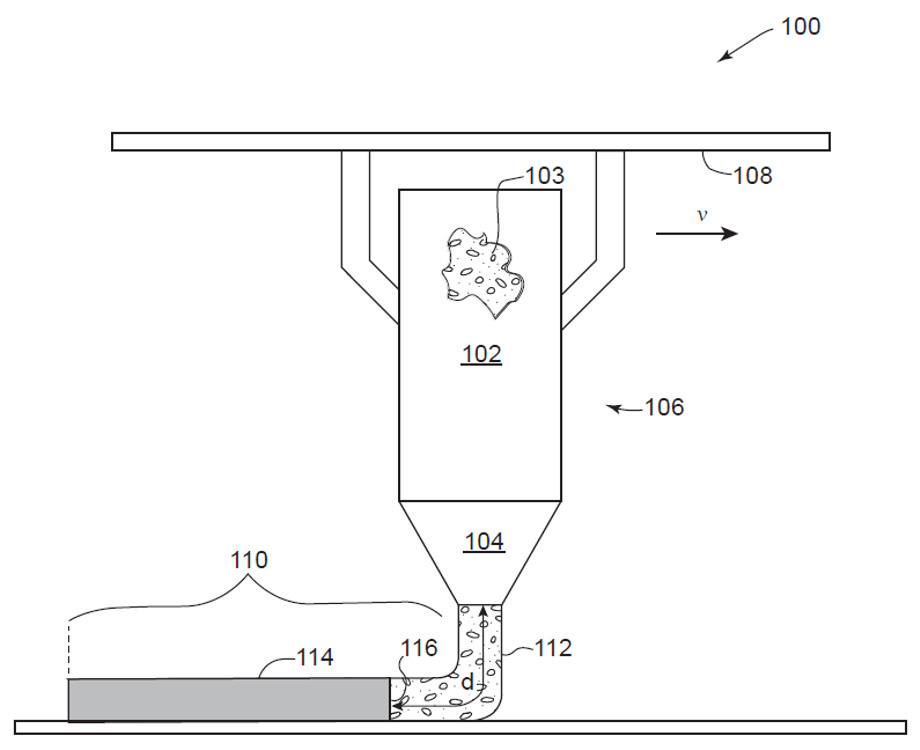
Fig. 1
Benefits
- Rapid setting, within seconds after extrusion
- Lower carbon intensity compared to conventional concrete formulations
- High compressive strength and structural integrity
Applications
- 3D printed housing
- Rapid deployment infrastructure (disaster relief, military, etc.)
- Rural and remote infrastructure development
- Modular construction
Status
Seeking development partner, commercial partner, licensing. US Provisional Patent 63/783,156