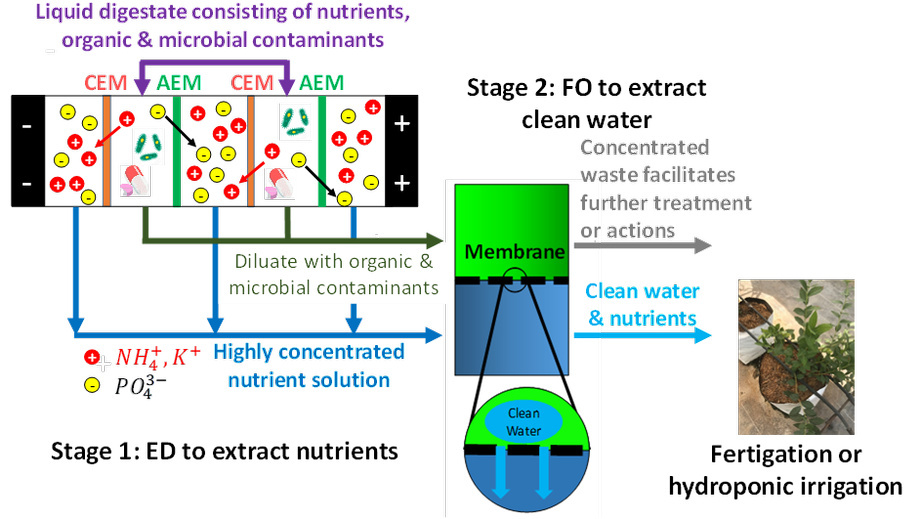
This process is a combination of electrodialysis (ED) and forward osmosis (FO) to recover nutrients and water from wastewater streams.
Background
The agriculture sector is the largest freshwater consumer in the United States, accounting for up to 70% of available freshwater withdrawals. However, water shortage has been exacerbated and is becoming a critical problem in many regions of the country where more frequent and intense droughts are expected. Given that water shortages in agriculture can have far-reaching effects on food security, more and more regions see irrigation with reclaimed water as an opportunity to secure and enhance agricultural production. Despite the benefits of water reuse, problems concerning the release of organic micropollutants, wastewater-borne antibiotics, antibiotic-resistant bacteria (ARB), and their determinant genes (antibiotic resistance genes (ARGs)) into the environment and food crops irrigated with treated wastewater are starting to gain attention. For these reasons, there is a critical need for effective treatment technologies that provide safe reclaimed water for agricultural irrigation.
Technology Description
This system combines electrodialysis (ED) and forward osmosis (FO) in a hybrid system that can recover valuable nutrients and reclaimed water from wastewater streams for use in agricultural applications. In FO, a waste stream containing contaminants, including organic compounds and bacteria, is separated from a draw solution by a semipermeable membrane to ‘draw’ clean water from the waste stream. Paired with ED, which uses an electric potential to drive ions through an ion selective membrane, one can generate a nutrient rich stream free of undesirable organic or bacterial contaminants.
Further Details:
Additional public information is available in the following publications:
https://doi.org/10.1016/j.jece.2024.112091
https://doi.org/10.1016/j.seppur.2024.130164
Benefits
- lower cost compared to conventional treatment technologies
- recovery of valuable nutrients
- reduced loss of nutrients through runoff
- helps water conservation through reclamation of wastewater
Applications
- fertigation for fruit and vegetable growers
- water recovery from anaerobic digesters in livestock operations
- water recovery from anaerobic digesters in food, beverage, and municipal facilities
Opportunity
Oregon State University is seeking development partners for scaling and commercialization.
Status
Patent application submitted 18/923,444